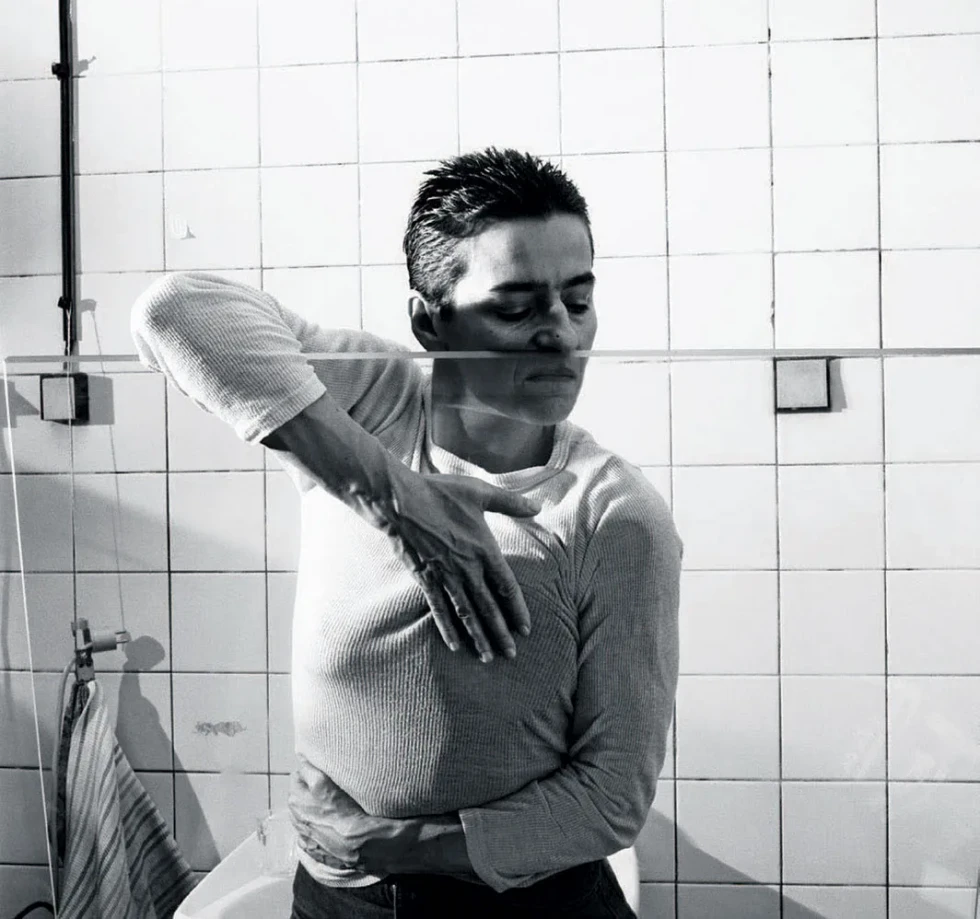
Image: Anchan/Anna Daučíková, Upbringing by Touch, 1996/2020, one of five ink-jet prints on aluminum, 80 x 84cm
Takes on Transparency
June 13 – August 30, 2026
PAULINE CURNIER JARDIN and FEEL GOOD COOPERATIVE
ANCHAN/ANNA DAUČÍKOVÁ
ILKE GERS
WILLEM OOREBEEK
Guest curated by RUTH NOACK
Guest writer: TILLY LAWLESS
The meaning of transparency is, on its face, clear—it is, after all, a synonym for clarity. And yet, the term has been associated with a wealth of different concepts: The call for transparency in governance is presumed to empower those that are governed. But transparency turns adversarial when the state begins surveilling its citizens. Transparency can function as an element of modernist architecture, for example, when a glass facade enables light to travel fluidly between inside and outside. Or it operates as a trope of modernity itself, symbolising the ideals of openness and visibility, equality and freedom. With this in mind, the exhibition Takes on Transparency brings together four artworks made over the course of the last thirty years, each approaching transparency from a distinct angle:
In Projections from the Observatory (2026), Ilke Gers casts light through a series of inkjet prints of gestural graphite drawings, the final step in a sequence of artistic operations that foreground the material traces of her own visualisation processes, positing them as a challenge to the supposed rational neutrality of scientific, optical and ballistic image technologies.
In Upbringing by Touch (1996/2020), Anchan/Anna Daučíková negotiates (supposedly) transparent media—a sheet of glass and the photographic apparatus—to counter social projections of gender onto her body, taking the right to form her own.
In Monochromatic Studies (2007), Willem Oorebeek has pulled colour over local election posters like sheets of glass, his overprints denaturing the politician’s self-representations. By this simple printer’s gesture, he interrupts the logic of mass-produced visuality and opens up alternative perceptions.
In Fireflies (Lucciole) (2021), a collaboration between Pauline Curnier Jardin and Feel Good Cooperative—a social collective founded by the artist, an architect and a group of sex workers in Rome in 2020—light functions as a situational, relational and ethical medium that unfolds a poetics of transparency and opacity. Illuminated and illuminating, the women negotiate visibility and vulnerability, carving out a space of intimacy and self-care.
In the spirit of the exhibition, it feels fitting to offer our own disclaimers and disclosures: Takes on Transparency does not aim to fully explain or define the concept of transparency. The exhibition grew from guest curator Ruth Noack’s method of thinking through issues with the help of art in an open-ended process of research. It is the materialisation of this process in one instance of exhibition-making and it invites viewers to join in the practice of knowledge production that comes from looking at art.
Additionally, Takes on Transparency was originally inspired by the large glass windows of modernist Haus Lemke by Mies van der Rohe, but when a show conceived for that venue was not selected and remained unrealised, it was out of strong friendship that director Isabelle Sully invited Ruth Noack, a former teacher and ongoing mentor of hers, to materialise her research at A Tale of A Tub. The exhibition therefore finds its home in another piece of historic modernist housing—the Justus van Effencomplex—throughout which architect Michiel Brinkman let function follow form, particularly when it came to the placement of windows. Beyond the complex, the glass window pane also has a larger cultural significance within the Netherlands, with the ‘Dutch window’ being a cultural phenomenon wherein locals leave their large, ground-floor windows uncurtained and open, offering a clear view into their homes, a practice rooted in seventeenth-century Calvinist values and a plight for moral transparency. In the end, though, this exhibition is a way of giving something back, of saying thank you. In its reciprocity of friendship and exhibition-making, a working reality is made transparent, one in which the ever-common though often unshared vulnerability of rejection is laid bare and reconfigured into something else.
Biographies
PAULINE CURNIER JARDIN is an artist working across installation, performance, film and drawing. Her cinematic installations create unorthodox universes and tell stories, thus proposing alternative narratives. She is the winner of the 2019 German Preis der Nationalgalerie, the 2021 Villa Romana Prize in Firenze and recipient of the 2019–2020 Villa Medici fellowship in Rome.
ANCHAN/ANNA DAUČÍKOVÁ lives and works in Prague. They were a pioneer of feminist-queer art and an activist and spokesperson for LGBTQI+ rights in Slovakia in the 1990s. Alongside their many years of teaching at several art academies, they have focused on the format of the video essay, bringing in social issues such as poverty, post-Soviet trauma and memory. Their artistic practice spans painting, photography, performance, installation and moving images. In their photography and video work they explored potentials of queering and non-normative sexualities, resulting in gestural creations whereby the artist’s own body and body movements are performed in photo-series and multi-channel video installations.
ILKE GERS is a visual artist from Aotearoa New Zealand, based in Rotterdam. Working between drawing, writing, print and publishing, she explores possibilities for language, movement and perception to be represented through processes that deviate from standardised capitalist structures of production. Experimenting with everyday and industrial materials, tools and processes intended to mechanise, organise, divide and circulate, she develops open-ended systems that are specific to, and contingent on the situation and context which work is made, while implicating the body and its idiosyncrasies, allowing for friction, irregularity, improvisation and change over time.
TILLY LAWLESS is a queer, Sydney-based sex worker, writer and (sometimes) performer. Her first book, Nothing But My Body, was published in 2021 and her second, Thora, was published in 2024. She is a regular contributor to both Prospect Magazine and New World Magazine.
RUTH NOACK is an exhibition maker, art historian, author and educator. The curator of documenta 12 in 2007, her exhibitions, like her teaching career, span more than thirty years. Between 2019–21, she built The Corner at Whitman-Walker in Washington, D.C., an art institution working at the intersection of LGBTQI+ healthcare, community and contemporary art. Noack has published widely, including a monograph on Sanja Iveković. She holds a professorship of Art and Public at Kunstakademie Düsseldorf, where she also directs the Akademie-Galerie. Notable amongst her contributions as advisor and mentor is her work for Lidice Art Collection and Kreisau Foundation for European Understanding—two institutions in Eastern Europe that emerged from a sense of historical responsibility towards the crimes committed by Germans during the National Socialist period.
WILLEM OOREBEEK lives and works in Brussels. His work explores the production, circulation and social functions of printed matter. Through overprinting and reproducing images appropriated from mass media, he examines representational strategies and perception in an age saturated by spectacle and visual overload. He represented the Netherlands at the 1997 Venice Biennale alongside Aernout Mik and supervised WIELS’ residency programme from 2008 to 2020. In 2025, WIELS Brussels presented a major survey exhibition of his work.